
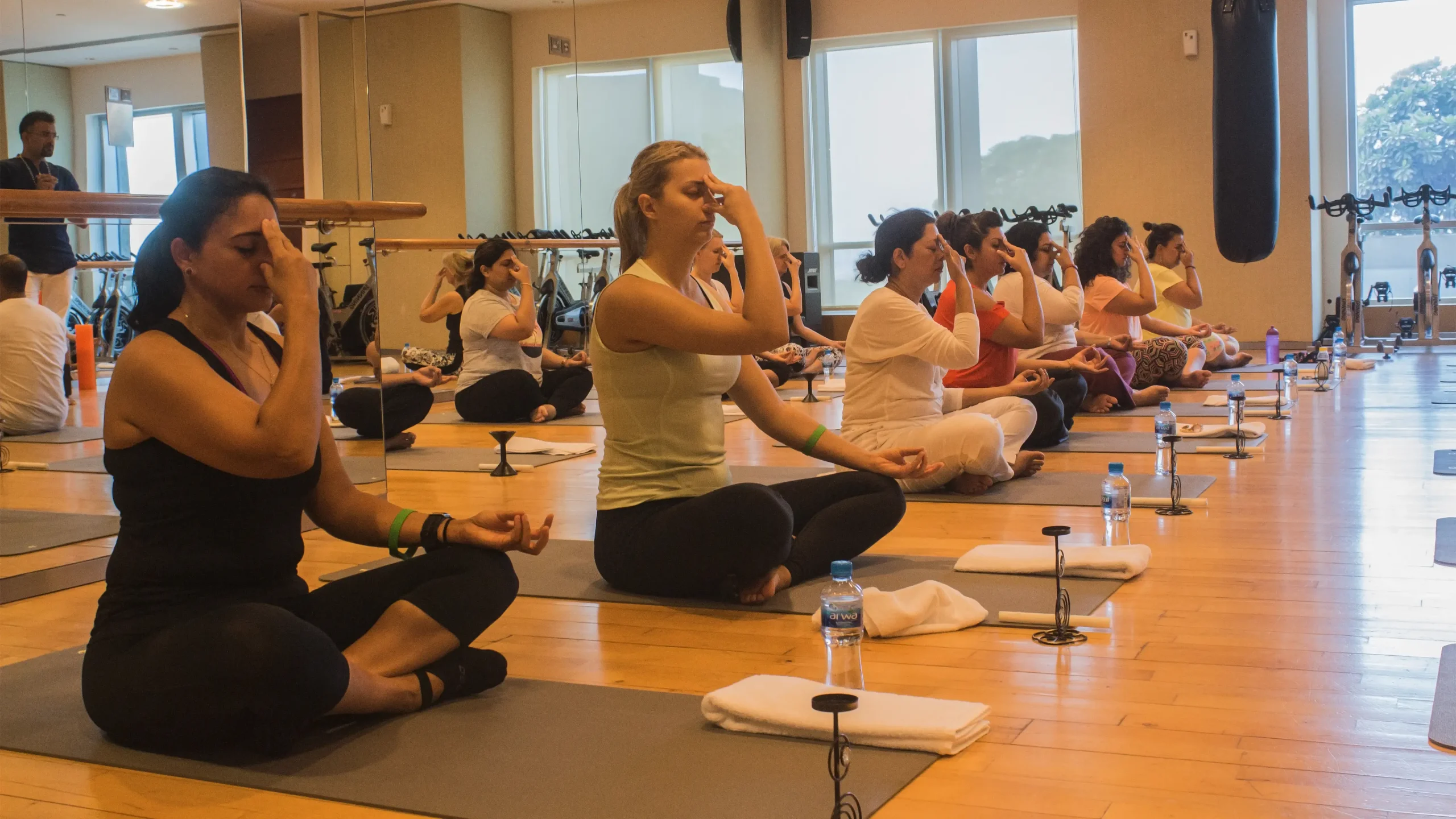
Something nobody in the wellness industry wants to admit: for a significant number of people, yoga is not working. Not because they are doing it wrong. Not because they are not committed enough. Because they are practising the wrong type of yoga for their body.
This is not a fringe idea. It is rooted in 5,000 years of Ayurvedic medical science — the same tradition that yoga was born within. And it explains why so many dedicated practitioners leave class feeling drained instead of restored, more anxious instead of calmer, or simply stuck at the same place year after year despite consistent effort.
If you have ever wondered why yoga is not giving you what it promised, this article is the honest answer.
Walk into almost any yoga studio in the world and you will find the same experience. You pay for a class. You roll out your mat. You do what everyone else in the room does — the same sequence, the same cues, the same pace — and you go home.
Nobody asked about your constitution before you began. Nobody asked whether you run hot or cold, whether you sleep lightly or deeply, whether stress makes you anxious or irritable or withdrawn. Nobody asked, because the commercial yoga model cannot accommodate those questions in a group class.
This is how yoga has worked globally for the last 50 years. And it is the reason a lot of people who practise consistently are still waiting for the transformation they were promised.
In classical Ayurveda — the ancient Indian medical system that yoga grew from — you did not receive a yoga practice without first being assessed by a teacher who understood your constitutional type. Your Prakriti. The unique biological pattern that determines which yoga heals you and which yoga quietly harms you.
That knowledge was the foundation of the tradition. It was removed when yoga became a commercial fitness product. And the consequences are showing up in the bodies and minds of practitioners every day.
One of the students who came to me about four years ago had been practising dynamic Vinyasa six mornings a week for three years. She was committed. She never missed a session. She had invested in the right mat, the premium studio membership, the workshops.
She came to me because the anxiety that had brought her to yoga in the first place had not shifted. Her sleep was still fragmented. She would leave class feeling briefly elevated and then depleted within an hour. She had tried therapy, nutrition, meditation apps — everything the wellness world had to offer. Something was still not working and she did not know what.
She was a Vata type — constitutionally dominated by Air and Space. Light, quick, anxious, cold. And she had been practising hot Vinyasa — one of the most stimulating, heating and physiologically depleting practices available — every single morning.
“She was doing yoga every day for three years. The yoga was making her worse. Not the practice — the mismatch between the practice and her constitution.”
Within two weeks of switching to a slow, grounding Hatha practice — long holds, warm room, predictable sequence — she was sleeping through the night. Within three weeks the anxiety had become occasional rather than constant. Within six weeks she described feeling, for the first time, that yoga was actually working.
She cried in Shavasana. She said she had not realised her body knew how to rest like that.
This is the part that catches people out. The wrong yoga often feels good in the short term. A Vata type in hot Vinyasa gets a genuine dopamine and cortisol surge from the intensity. A Pitta type in Ashtanga feels the satisfying burn of effort and achievement. A Kapha type in a restorative Yin class feels the deep comfort of staying still.
These responses are real. They are just not the same as healing.
The Vata surge is followed by a crash that deepens the depletion it was supposed to address. The Pitta burn feeds the inflammatory fire it was supposed to cool. The Kapha comfort confirms the inertia it was supposed to shift.
The practice feels productive. The constitution is being driven further out of balance. And because the mismatch is not dramatic — it is quiet and cumulative — most people never connect the cause to the effect.
The classical Ayurvedic medical text, the Charaka Samhita, makes this explicit: a physician who does not know the Prakriti of the patient cannot treat the disease. Constitutional assessment before any yoga practice was not optional in the classical tradition. It was the first step.
When yoga crossed from India to the West and became a global fitness industry, the economics of scale made individual assessment impractical. You cannot run a studio on private consultations alone. Group classes require a standard product. And so the constitutional intelligence was quietly removed from the prescription.
The knowledge never disappeared. It is still in the classical texts. It is still taught in institutions like Dev Sanskriti Vishwavidyalaya in Haridwar where I completed my post-graduate diploma. What changed was the commercial context that surrounded the practice.
Modern research is now arriving at the same conclusions through a different door. Studies from the Indian Institute of Technology have found statistically significant correlations between Ayurvedic dosha classifications and measurable biological markers — genetic expression, microbiome composition, inflammatory levels. Precision medicine — the tailoring of health interventions to individual biological profiles — is the fastest-growing field in modern healthcare. Ayurveda was doing this five thousand years ago.
The first step is identifying your Prakriti — your constitutional type. This is not a personality quiz. It covers eight classical Ayurvedic diagnostic domains: physical frame, skin and hair, digestion, sleep patterns, energy, mind, emotional response and movement quality. Answered honestly based on your lifelong tendencies rather than your current state, the result gives you a clear picture of your dominant constitutional type.
Most people are one of three types — Vata, Pitta or Kapha — or a combination of two. The combination is actually the most common pattern. Vata-Pitta is particularly prevalent among high-performing urban professionals — creative and driven, quick and intense, anxious and ambitious simultaneously.
Once you know your type, the prescription changes everything. Not just which yoga classes to attend. Which time of day to practise. Which breathing techniques support your constitution. Which dietary principles apply. How your practice should shift with the season.
This is what the Ayurvedic yoga prescription system gives you. Not a class you attend. A practice that was made for your specific body.
12 questions · 8 Ayurvedic domains · 3 minutes · Instant personalised result
www.lifestyleyogaworld.com/know-your-dosha
The clearest signals are: feeling depleted rather than energised after class, persistent anxiety or irritability that yoga has not shifted despite consistent practice, energy that spikes briefly after class and crashes within an hour, or a sense that your key health issue is the same or worse after months of practice. These are constitutional mismatches, not personal failures.
Not in an acute, dramatic way — yoga is not dangerous. The harm from constitutional mismatch is cumulative and quiet. A Pitta type in hot yoga every day for two years may find their inflammatory markers rising, their joints becoming sensitive, their emotional resilience declining. The practice appears fine from the outside. The constitution is being slowly pushed further out of balance.
Not necessarily immediately. Start by understanding your constitutional type and then gradually shift your practice toward what your type needs. Even one class per week of the right practice begins to create change. A complete switch produces faster results, but any movement in the right direction is beneficial.
Sumit Manav is a classical yoga master with 25 years of teaching experience. He trained in the Himalayan tradition, is certified in the BKS Iyengar lineage, and holds a Post-Graduate Diploma from Dev Sanskriti Vishwavidyalaya, Haridwar. Since 2009 he has been the resident yoga master at the Shangri-La Hotel, Sheikh Zayed Road, Dubai, teaching over 10,000 students from 40 countries. He is the founder of Lifestyle Yoga World and creator of the Yoga by Dosha system — the world’s first commercially deployed Ayurvedic yoga prescription platform.
www.lifestyleyogaworld.com · +971 566 241002 · info@www.lifestyleyogaworld.com
These questions help us understand your natural, lifelong patterns — how you have generally been since childhood. Please answer based on your usual nature, not on how you feel these days.
You’ll only complete this part once.
This number is already linked to your saved Prakriti baseline.
Your existing Constitution stays saved. The new number will need its own Step 1 assessment.
Use the name you would like us to keep with your assessment.
We use your WhatsApp number to identify your Constitution baseline and keep your future check-ins connected.
You're ready for Step 2. We'll now look at how you've been feeling over the last 30 days.